Production considerations
Sandbox demo vs production
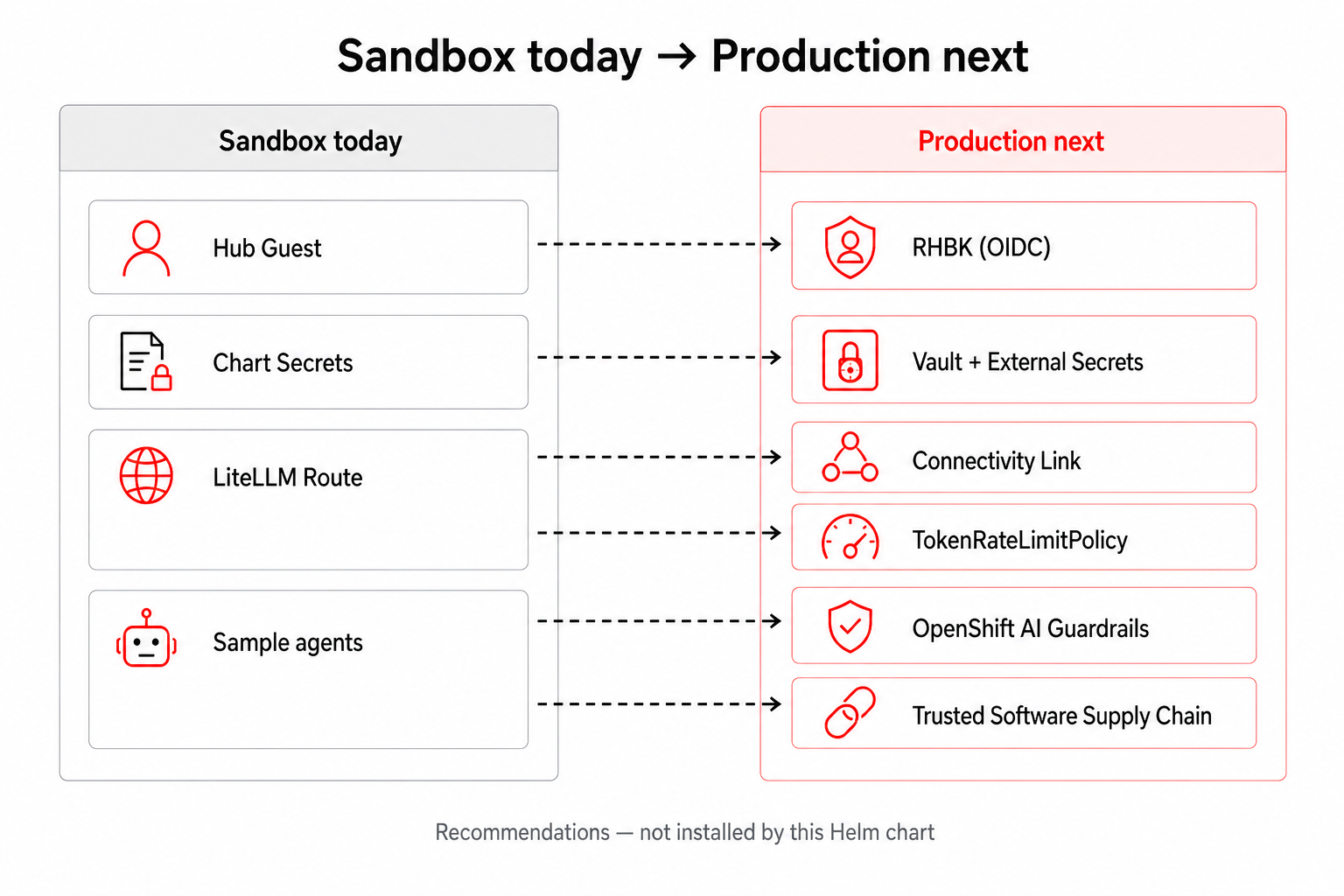
This umbrella chart targets OpenShift Developer Sandbox: Guest Hub login, chart-generated Secrets, shared Granite/Qwen via LiteLLM, and optional OpenClaw. The products below are enterprise recommendations when you move the same agentic RHDH pattern to a managed OpenShift cluster. They are not installed by this Helm chart.
Use this page as a short map from “what works in Sandbox” to “what to add for production identity, secrets, gateway control, AI safety, and CI/CD”.
At a glance
| Capability | Replaces / hardens in this demo | Primary product |
|---|---|---|
| Identity | Hub Guest + static mcp-token |
Red Hat build of Keycloak |
| Secrets | Literals in rhdh-agent-sandbox-secrets |
Vault + External Secrets Operator |
| North–south API control | Open Routes to LiteLLM / Hub | Red Hat Connectivity Link |
| Fair / cost-aware LLM use | No token quotas | TokenRateLimitPolicy |
| Prompt / response safety | No content detectors | OpenShift AI Guardrails (TrustyAI) |
| Agent image / template CI/CD | Manual / ad-hoc builds | Trusted Software Supply Chain (RHADS-SSC) |
1. Red Hat Connectivity Link
Why: Put Gateway API policies in front of LiteLLM, Hub APIs, and agent HTTP endpoints so auth, routing, and rate limits are enforced outside the pods.
Vs Sandbox today: LiteLLM and Hub are exposed with OpenShift Routes and chart secrets; there is no AuthPolicy / GatewayPolicy layer.
Learn more:
- Red Hat Connectivity Link documentation
- Configuring and deploying gateway policies (AuthPolicy, RateLimitPolicy, DNSPolicy)
2. TokenRateLimitPolicy (controlled agent usage)
Why: LLM cost tracks tokens, not request count. TokenRateLimitPolicy extracts OpenAI-style usage.total_tokens and enforces per-user or per-group budgets (for example free vs pro), returning HTTP 429 when limits are exceeded. Pair with Connectivity Link AuthPolicy so identity drives the limit.
Vs Sandbox today: Shared models and LiteMaaS have no chart-managed token budget; a noisy agent can consume quota freely.
Learn more:
- Configure token-based rate limiting with TokenRateLimitPolicy
- Manage AI resource use with TokenRateLimitPolicy (Red Hat Developer)
3. Red Hat build of Keycloak (RHBK)
Why: Replace anonymous Guest (and long-lived static MCP tokens) with enterprise OIDC: realms, groups, MFA, and short-lived tokens for Hub, Lightspeed, and gateway AuthPolicy.
Vs Sandbox today: Hub Guest for demos; mcp-token / litellm-master-key are chart-generated Secrets.
Learn more:
- Red Hat build of Keycloak documentation
- RHBK Operator guide
- Server Administration Guide — features and concepts
4. Vault + External Secrets Operator
Why: Keep litellm-master-key, mcp-token, LiteMaaS / model keys, and agent credentials in a vault (for example HashiCorp Vault). Sync them into Kubernetes with External Secrets Operator for Red Hat OpenShift so pods never depend on Helm --set secrets or unrotated literals.
Vs Sandbox today: Secrets are created/preserved by the chart; rotation of model-api-key is a manual oc whoami -t patch.
Learn more:
- External Secrets Operator for Red Hat OpenShift (providers include HashiCorp Vault, cloud secret managers)
- HashiCorp Vault documentation
5. OpenShift AI Guardrails (AI safety)
Why: Run detectors on LLM inputs and outputs (PII, hate/profanity, prompt injection, custom rules) via TrustyAI-managed Guardrails Orchestrator / FMS Guardrails — in front of or beside the same LiteLLM / model path agents use.
Vs Sandbox today: Lightspeed, Continue, sample agents, and OpenClaw call models with no content-safety orchestrator in this chart.
Learn more:
- Ensuring AI safety with guardrails (OpenShift AI Self-Managed)
- Using FMS Guardrails for AI safety
6. Trusted Software Supply Chain (CI/CD for agents)
Why: Treat agent images, scaffolder skeletons, and MCP sidecars like any production workload: signed builds, SBOM, CVE scan, and policy gates before they land in the cluster. Red Hat’s portfolio (productized as Red Hat Advanced Developer Suite — software supply chain, formerly Trusted Application Pipeline / Trusted Software Supply Chain) combines Developer Hub templates with Pipelines, Quay, Trusted Artifact Signer, Profile Analyzer, and ACS.
Vs Sandbox today: Sample agents are chart ConfigMap stubs; Golden Paths deploy without a signed supply-chain pipeline.
Learn more:
- Understanding RHADS — software supply chain
- Red Hat Trusted Software Supply Chain (product overview)
- Related building blocks: OpenShift Pipelines, Red Hat Quay
Suggested adoption order
- RHBK + Vault/ESO — stop Guest-only and secret sprawl.
- Connectivity Link + TokenRateLimitPolicy — protect LiteLLM / agent Routes and budget tokens.
- Guardrails — safety on the inference path.
- Trusted Software Supply Chain — harden how agent artifacts are built and promoted.
Related
- Architecture — what this chart deploys today
- Lightspeed & models — Sandbox model aliases and LiteMaaS
- AI capabilities — Hub / MCP / agents surface
- Troubleshooting — Sandbox-specific failures