Service Interconnect (Skupper)
Git path: charts/all/service-interconnect/
What problem does it solve?
East and west spokes run Kafka, Prometheus, and Industrial Edge gateways on private cluster networks. The hub needs to reach those services for Grafana, Kafka Console, and hub-gateway routing — without exposing public endpoints, configuring site-to-site VPNs, or punching firewall holes.
Red Hat Service Interconnect (Skupper) builds a Virtual Application Network (VAN) over TLS between clusters. Spoke Connectors publish local services; hub Listeners expose them as in-cluster DNS names (kafka-east-tst.service-interconnect.svc.cluster.local). Operators get cross-cluster connectivity with mTLS between Skupper routers, not workload-level VPN tunnels.
| Alternative | Limitation in this pattern |
|---|---|
| Public Routes per service | Too many endpoints; security exposure |
| Site-to-site VPN | Network team dependency; brittle for demos |
| Service Mesh multi-cluster | Requires shared trust domain + east-west gateways |
| Skupper VAN | Application-layer TCP bridge; works with existing mesh |
Namespace: service-interconnect on hub and spokes. Hub chart: charts/all/service-interconnect. Spoke chart: charts/all/spoke-interconnect (sync wave 6).
Red Hat Service Interconnect creates a Virtual Application Network (VAN) that connects services across clusters without requiring VPN tunnels, direct network routes, or firewall changes. In this platform, Skupper bridges spoke Industrial Edge services and Prometheus metrics to the hub for centralized observability.
The diagram below shows listeners and connectors only. For Kafka Console screenshots and broker DNS details, see AMQ Streams and Observability — Kafka Console (same topic, split so Skupper stays focused on VAN mechanics).
Architecture
flowchart TB
  subgraph Hub["Hub Cluster"]
    direction TB
    SITE_H["Skupper Site (hub)<br/>namespace: service-interconnect"]
    AG["AccessGrant<br/>(spoke-link)"]
    L_GW_E["Listener: ie-gateway-east<br/>port 8080"]
    L_GW_W["Listener: ie-gateway-west<br/>port 8080"]
    L_PM_E["Listener: prometheus-east<br/>port 9091"]
    L_PM_W["Listener: prometheus-west<br/>port 9091"]
    L_K_E["Listener: kafka-east-tst<br/>port 9092"]
    L_K_W["Listener: kafka-west-tst<br/>port 9092"]
    GRAFANA["Grafana Datasources"]
    KAFKA_C["Kafka Console"]
    L_PM_E -->|"svc.cluster.local"| GRAFANA
    L_PM_W -->|"svc.cluster.local"| GRAFANA
  end

  subgraph East["East Spoke"]
    SITE_E["Skupper Site (east)"]
    TOKEN_E["AccessToken<br/>(hub-token)"]
    CONN_GW_E["Connector:<br/>ie-gateway-east"]
    CONN_PM_E["Connector:<br/>prometheus-east"]
    CONN_K_E["Connector:<br/>kafka-east-tst"]
    SGW_E["Spoke Gateway<br/>:8080"]
    TQ_E["Thanos Querier<br/>:9091"]
    KAFKA_E["Kafka bootstrap<br/>:9092"]
    SGW_E --> CONN_GW_E
    TQ_E --> CONN_PM_E
    KAFKA_E --> CONN_K_E
  end

  subgraph West["West Spoke"]
    SITE_W["Skupper Site (west)"]
    TOKEN_W["AccessToken<br/>(hub-token)"]
    CONN_GW_W["Connector:<br/>ie-gateway-west"]
    CONN_PM_W["Connector:<br/>prometheus-west"]
    CONN_K_W["Connector:<br/>kafka-west-tst"]
    SGW_W["Spoke Gateway<br/>:8080"]
    TQ_W["Thanos Querier<br/>:9091"]
    KAFKA_W["Kafka bootstrap<br/>:9092"]
    SGW_W --> CONN_GW_W
    TQ_W --> CONN_PM_W
    KAFKA_W --> CONN_K_W
  end

  AG -.->|"redeem"| TOKEN_E
  AG -.->|"redeem"| TOKEN_W
  TOKEN_E -->|"TLS link"| SITE_H
  TOKEN_W -->|"TLS link"| SITE_H
  CONN_GW_E ===|"VAN"| L_GW_E
  CONN_PM_E ===|"VAN"| L_PM_E
  CONN_GW_W ===|"VAN"| L_GW_W
  CONN_PM_W ===|"VAN"| L_PM_W
  CONN_K_E ===|"VAN"| L_K_E
  CONN_K_W ===|"VAN"| L_K_W
  L_K_E --> KAFKA_C
  L_K_W --> KAFKA_C
Link establishment flow
The Skupper link between spoke and hub requires an AccessToken that is created from the hub’s AccessGrant:
sequenceDiagram
  participant Hub as Hub (AccessGrant)
  participant GrantSrv as Grant Server (HTTPS)
  participant Spoke as Spoke (AccessToken)
  participant Router as Skupper Router

  Hub->>GrantSrv: Create AccessGrant → generates URL + code
  Note over Hub: AccessGrant status.url + status.code + status.ca
  Spoke->>GrantSrv: Redeem token (ca + code + url)
  GrantSrv-->>Spoke: TLS credentials
  Spoke->>Spoke: Create Link with TLS credentials
  Spoke->>Router: Establish inter-router connection
  Router-->>Hub: VAN link active
  Note over Hub,Spoke: Connectors ↔ Listeners now bridged
Components
Hub (charts/all/service-interconnect)
| Resource | Purpose |
|---|---|
Site/hub | Declares the hub as a Skupper site |
AccessGrant/spoke-link | Generates claim tokens for spoke connections |
Listener/ie-gateway-east | Receives spoke-gateway traffic from east |
Listener/ie-gateway-west | Receives spoke-gateway traffic from west |
Listener/prometheus-east | Receives Prometheus metrics from east |
Listener/prometheus-west | Receives Prometheus metrics from west |
Listener/kafka-east-tst | Kafka bootstrap (dev-cluster) from east |
Listener/kafka-west-tst | Kafka bootstrap (dev-cluster) from west |
Listener/kafka-east-stormshift | Kafka bootstrap (factory-cluster) from east |
Listener/kafka-west-stormshift | Kafka bootstrap (factory-cluster) from west |
Spoke (charts/all/spoke-interconnect)
| Resource | Purpose |
|---|---|
Namespace/service-interconnect | Skupper workspace |
Site/<clusterName> | Declares the spoke as a Skupper site |
Connector/ie-gateway-<cluster> | Exposes local spoke-gateway to hub |
Connector/prometheus-<cluster> | Exposes auth proxy → Thanos Querier to hub |
Connector/kafka-<cluster>-tst | Exposes dev-cluster-kafka-bootstrap to hub |
Connector/kafka-<cluster>-stormshift | Exposes factory-cluster-kafka-bootstrap to hub |
The AccessToken on each spoke is created automatically by a hub PostSync Job (charts/all/service-interconnect/templates/accesstoken-sync.yaml). The Job reads AccessGrant/spoke-link status (code, url, ca) at runtime and applies AccessToken/hub-link on each spoke through ManagedClusterAction — nothing sensitive is stored in Git.
| Mechanism | Purpose |
|---|---|
PostSync Job skupper-accesstoken-sync-hook | Runs after field-content-service-interconnect sync; links spokes when Site + grant exist |
CronJob skupper-accesstoken-sync | Re-reconciles tokens every 30 minutes (grant rotation, late spoke join) |
| ManagedClusterAction | Creates AccessToken CR on spoke (namespace: service-interconnect) |
| ManagedClusterView | Reads Link/hub-link status on spoke before re-applying token |
Prerequisites: ACM imported clusters (east, west), spoke Site deployed (spoke-interconnect wave 6), hub AccessGrant status populated.
Manual fallback (debug or without ACM):
CODE=$(oc get accessgrant spoke-link -n service-interconnect -o jsonpath='{.status.code}')
URL=$(oc get accessgrant spoke-link -n service-interconnect -o jsonpath='{.status.url}')
CA=$(oc get accessgrant spoke-link -n service-interconnect -o jsonpath='{.status.ca}')
# oc apply AccessToken on each spoke — see Getting Started Phase 3 step 5
How the VAN connection works
sequenceDiagram
  participant Hub as Hub cluster
  participant Grant as AccessGrant + grant server Route
  participant Sync as accesstoken-sync Job (hub)
  participant MCA as ManagedClusterAction
  participant Spoke as Spoke cluster
  participant Router as Skupper routers

  Hub->>Grant: AccessGrant status (code, url, ca)
  Note over Grant: Passthrough TLS — SkupperGrantServerCA
  Sync->>Grant: Read status (not from Git)
  Sync->>MCA: Create AccessToken template per spoke
  MCA->>Spoke: AccessToken hub-link in service-interconnect
  Spoke->>Grant: HTTPS redeem (code + ca + url)
  Grant-->>Spoke: Inter-router credentials
  Spoke->>Router: Link hub-link → remote site hub
  Router-->>Hub: VAN mesh (sitesInNetwork=3)
  Note over Hub,Spoke: Hub Listeners ↔ Spoke Connectors bridge TCP
- Hub
Site/hubexposes grant server and inter-router routes (linkAccess: route). AccessGrant/spoke-linkpublishes redeem URL + one-time code + CA in status (not spec).- Spoke
Site/<name>registers the local router; no link untilAccessTokenexists. AccessToken(created by sync Job) redeems the grant; Skupper createsLink/hub-linkwith correct router endpoints — do not hand-craftLinkYAML.- Connectors on spokes and Listeners on hub share a routing key (e.g.
kafka-east-tst); Skupper bridges TCP once the VAN is up.
AccessToken CA certificate
The Skupper grant server uses passthrough TLS termination on its OpenShift Route, presenting a self-signed certificate from SkupperGrantServerCA – not the OpenShift Ingress CA.
Extract the correct CA from the hub:
oc get secret skupper-grant-server-ca -n openshift-operators \
  -o jsonpath='{.data.ca\.crt}' | base64 -d
Using the wrong CA (e.g. OpenShift Ingress CA) causes x509: certificate signed by unknown authority when the spoke tries to redeem the token.
Kafka bootstrap over Skupper
Skupper forwards TCP to Kafka bootstrap (:9092). Hub Kafka Console and other hub clients use listener hostnames in service-interconnect:
# Hub listeners (charts/all/service-interconnect) — ebook Ch.6 / Ch.12 alignment
# kafka-east-tst:9092       → dev-cluster bootstrap (east)
# kafka-east-stormshift:9092 → factory-cluster bootstrap (east)
# kafka-east-datalake:9092   → prod-cluster bootstrap (east)
# kafka-west-tst:9092        → dev-cluster bootstrap (west)
# kafka-west-stormshift:9092 → factory-cluster bootstrap (west)
# kafka-west-datalake:9092   → prod-cluster bootstrap (west)
Console CR (charts/all/kafka-console) references these services:
spec:
  kafkaClusters:
    - name: dev-cluster-east
      properties:
        values:
          - name: bootstrap.servers
            value: kafka-east-tst.service-interconnect.svc.cluster.local:9092
Clients then receive broker metadata with spoke-internal DNS names that do not resolve on the hub until you add hub-side EndpointSlice mappings and matching Strimzi advertisedHost on spokes.
Step-by-step and screenshots: Observability → Kafka Console. External /api routing: Troubleshooting → Kafka Console 404.
Spoke gateway aggregation
Rather than exposing each Industrial Edge service individually, each spoke runs a Gateway API gateway (charts/all/spoke-gateway) that aggregates all services behind a single entry point. Skupper exposes only this gateway to the hub.
flowchart LR
  subgraph Spoke["Spoke Cluster"]
    GW["spoke-gateway<br/>(Istio Gateway)"]
    FE["line-dashboard"]
    AD["anomaly-detection"]
    MSG["messaging"]
    KB["kafka-bootstrap"]
    GW --> FE
    GW --> AD
    GW --> MSG
    GW --> KB
  end

  CONN["Skupper Connector"] --> GW
  CONN -->|"VAN"| LIST["Hub Listener<br/>ie-gateway-*"]
Network Console (Skupper GUI)
The Skupper Network Observer provides a web console to visualize the service interconnect topology, traffic flow, and process-level communication across clusters.
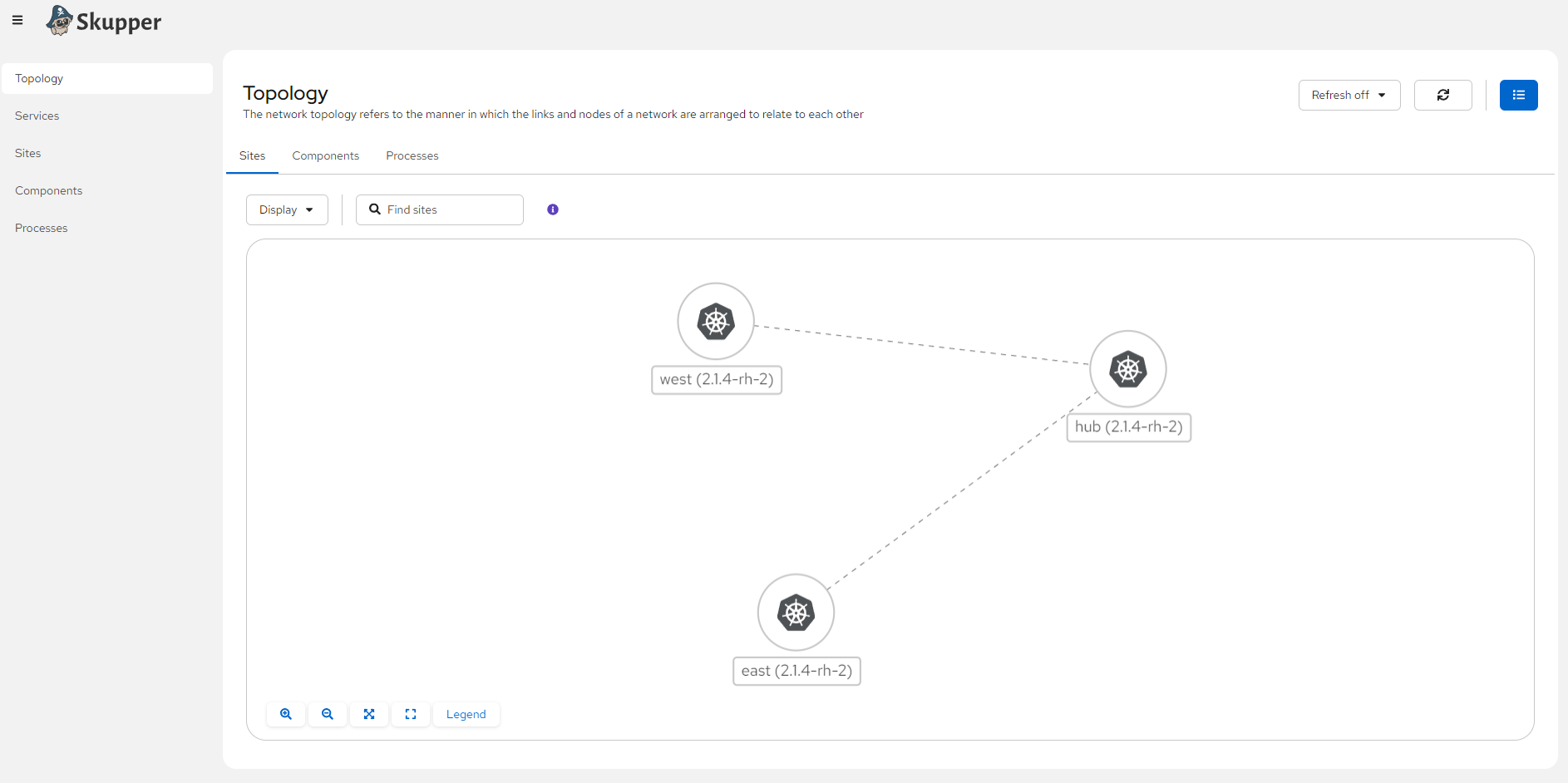
Sites view showing the hub, east, and west clusters linked via the Virtual Application Network.
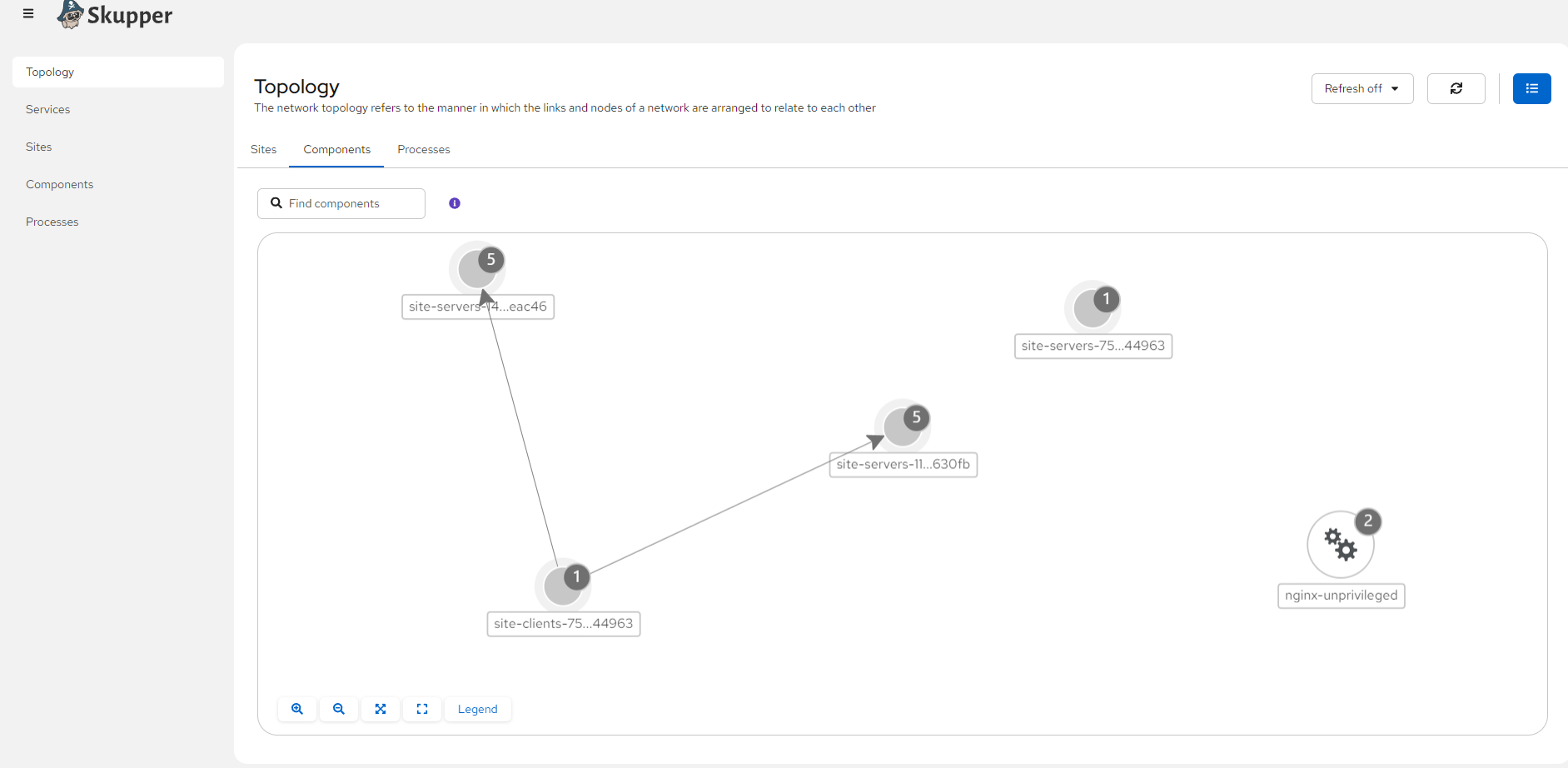
Components view with listeners and connectors bridging services across clusters.
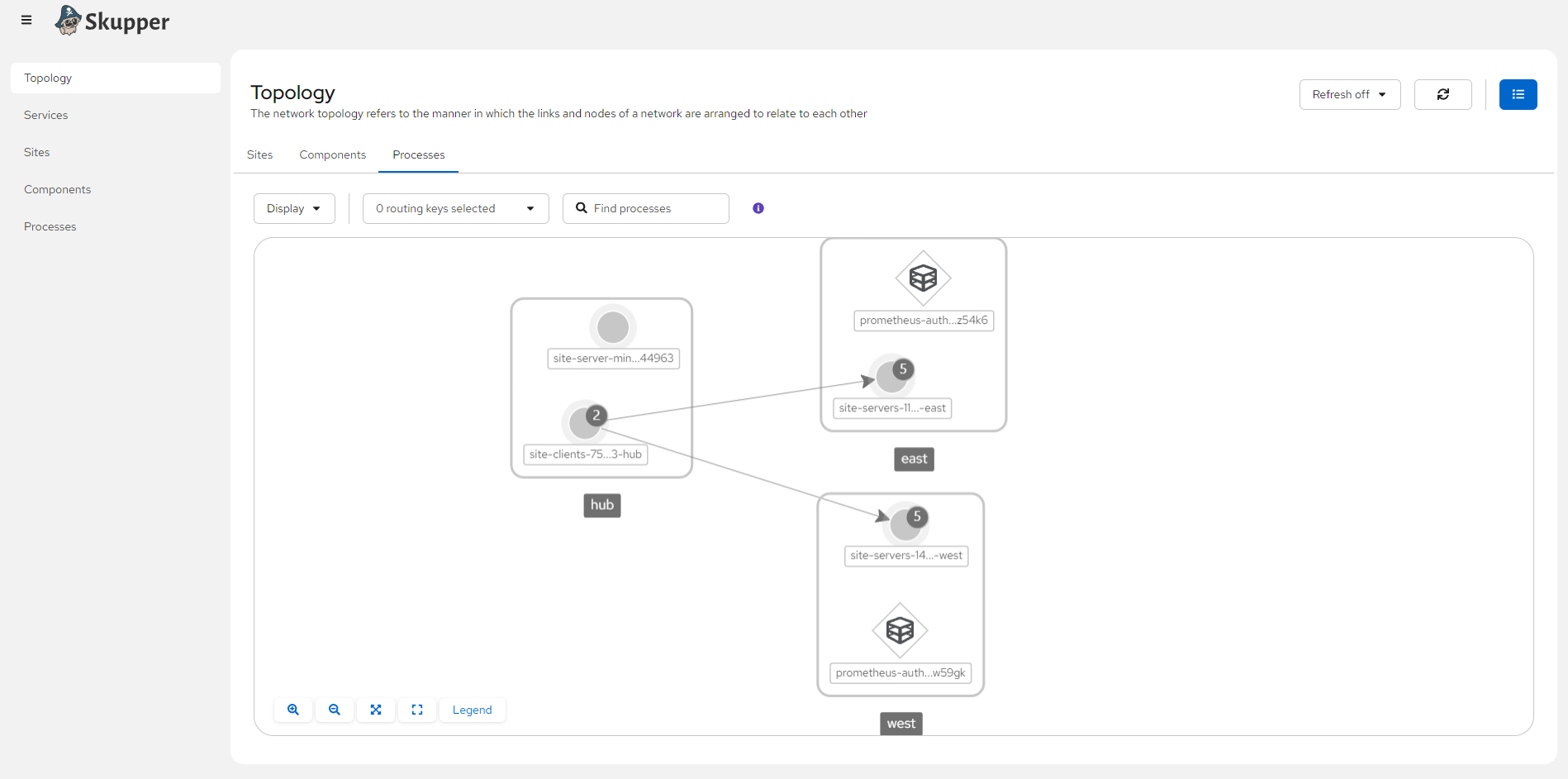
Process-level topology showing individual workloads and their cross-cluster connections.
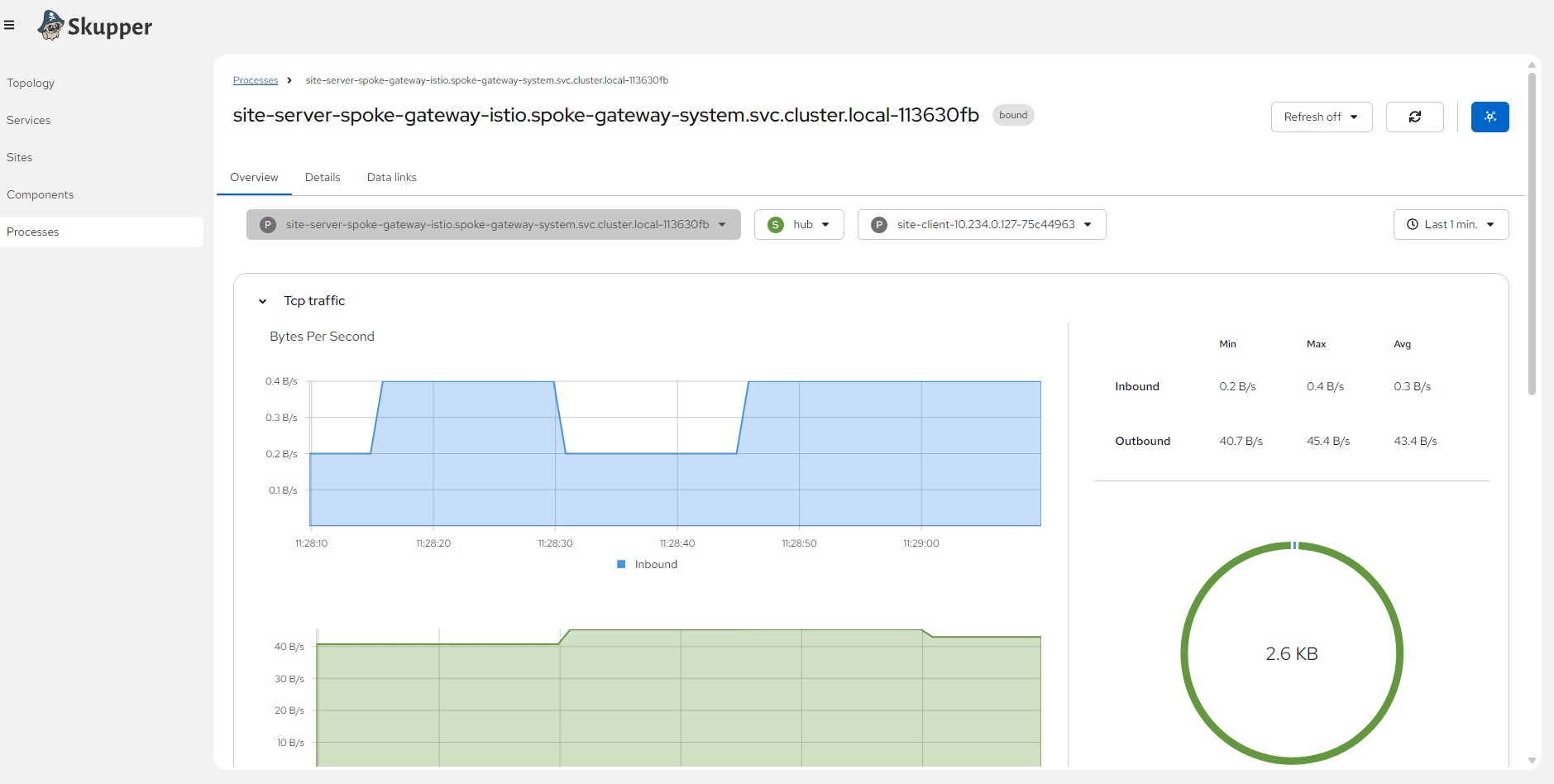
Process detail panel with connection metadata and traffic direction.
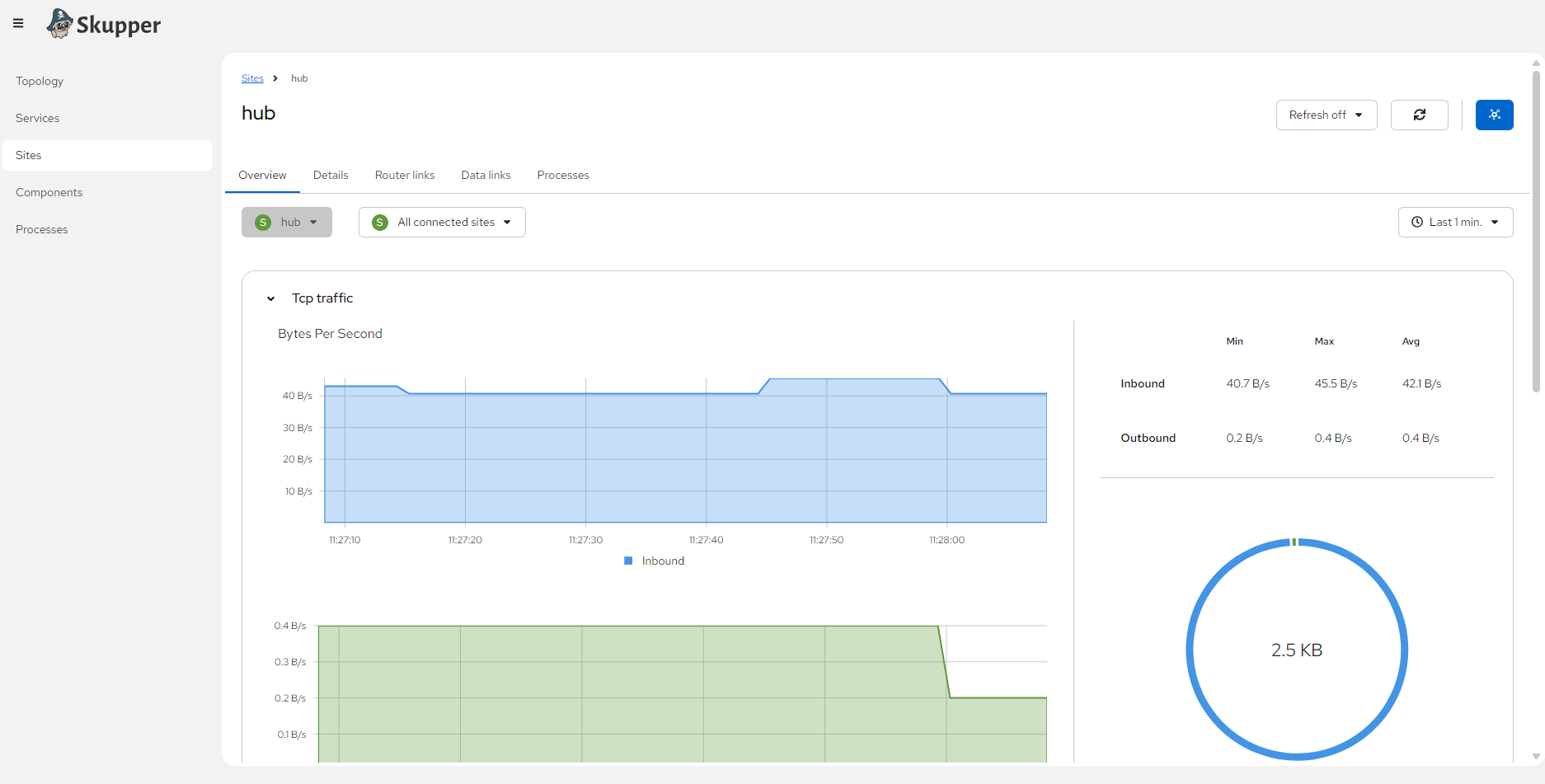
Built-in metrics view with Prometheus data for TCP bytes, latency, and connection counts.
Deployment notes
The Network Observer is deployed via the official OCI Helm chart (oci://quay.io/skupper/helm/network-observer). Key configuration:
auth.strategy: none— no OAuth proxy, direct accesstls.openshiftIssued: true— uses OpenShift service serving certificates (trusted by the router forreencryptTLS)tls.skupperIssued: false— prevents Skupper from overwriting the TLS secret with its own CA (which the router does not trust, causing 503)route.enabled: true— creates an OpenShift Route for external access
Operator deployment
The skupper-operator subscription is deployed to spokes via the operators component in the ApplicationSet valuesObject. This ensures the CRDs are available before Skupper CRs are applied.
Operator discovery
Skupper controllers reconcile Site, AccessGrant, AccessToken, Link, Listener, and Connector CRs (skupper.io / Skupper v2 APIs). Spokes expose workloads by targeting spec.routingKey / connector selectors — Kubernetes Deployments do not need Skupper annotations for discovery (CR linking wires listeners ↔ connectors).
Tokens (AccessToken) bridge clusters via HTTPS grant servers. The hub accesstoken-sync Job applies tokens on spokes at runtime; rotate the hub AccessGrant or re-sync field-content-service-interconnect when recycling demo clusters.
References
Charts: charts/all/service-interconnect (hub), charts/all/spoke-interconnect (spokes), charts/all/spoke-gateway (spokes).