RHBK + Data Grid — High Availability
Helm chart for Red Hat Build of Keycloak (RHBK) in High Availability mode with Red Hat Data Grid as external distributed cache and PostgreSQL as the shared database.
Add the Helm Repository
helm repo add rhbk-datagrid https://maximilianopizarro.github.io/rhbk-datagrid-sample/
helm repo update
Install
helm install ha rhbk-datagrid/rhbk-datagrid \
  -n keycloak-ha --create-namespace \
  --set admin.password=changeme \
  --set datagrid.credentials.password=s3cret \
  --set postgresql.credentials.password=dbpass
OpenShift Topology
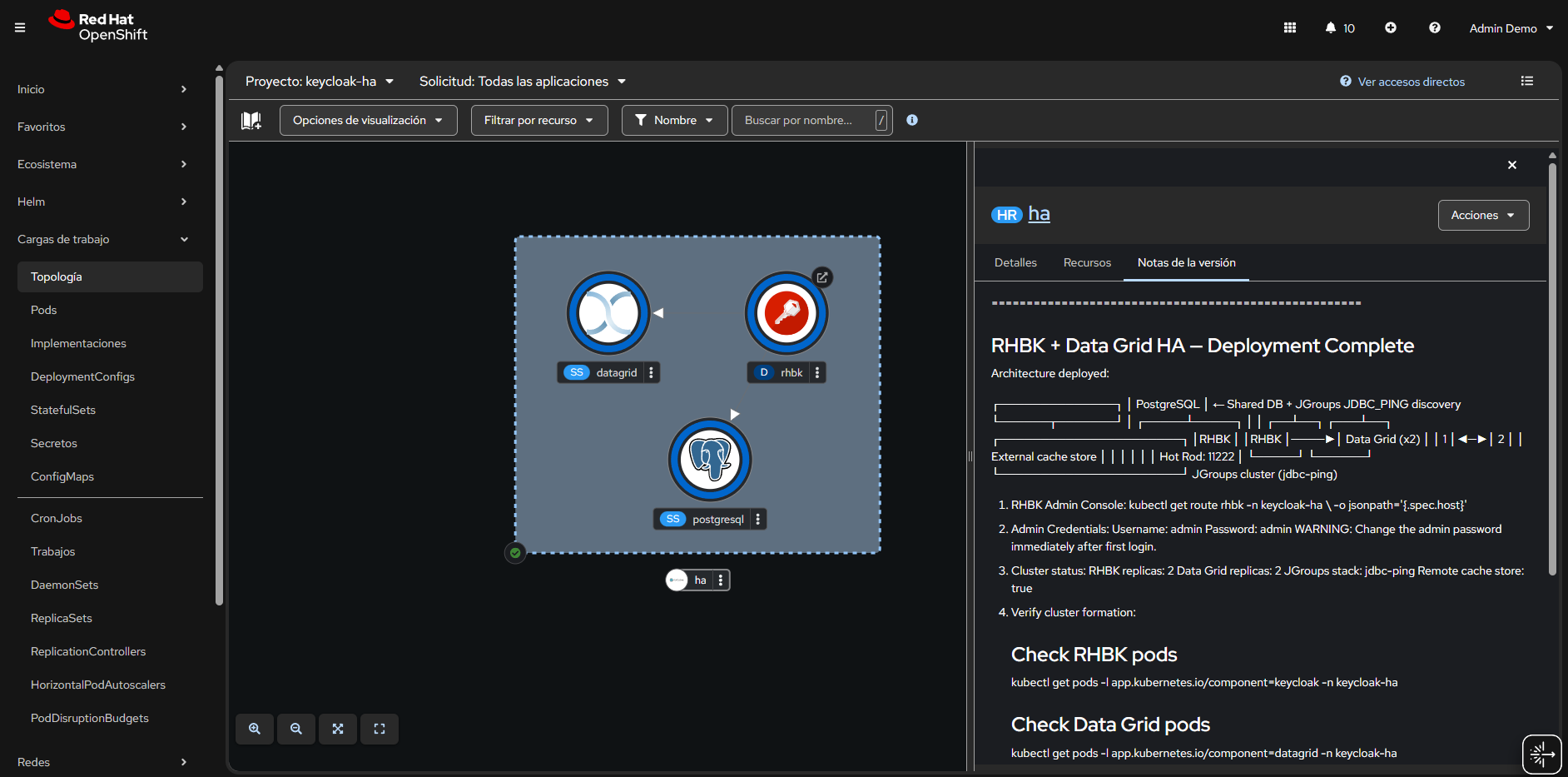
Architecture
┌──────────────────────────────────┐
│         PostgreSQL               │
│  Shared DB + JDBC_PING discovery │
└───────────────┬──────────────────┘
                │
        ┌───────┴───────┐
        │               │
   ┌────┴────┐   ┌──────┴──┐       ┌────────────────────────────┐
   │ RHBK-1  │   │ RHBK-2  │──────►│  Red Hat Data Grid (x2)    │
   │         │◄─►│         │       │  External distributed      │
   │ JGroups │   │ JGroups │       │  cache (Hot Rod: 11222)     │
   └─────────┘   └─────────┘       └────────────────────────────┘
        JGroups cluster
        (jdbc-ping via PostgreSQL)
Components
| Component |
Role |
| RHBK (x2) |
Two Keycloak instances clustered via JGroups using the jdbc-ping stack. The multi-site feature enables connection to an external Data Grid for distributed session caching. |
| Data Grid (x2) |
Two Infinispan server instances forming their own cluster via JGroups DNS_PING. They provide a remote distributed cache for Keycloak sessions. |
| PostgreSQL (x1) |
Single-instance database storing Keycloak data. Also serves as the registry for JGroups JDBC_PING2 node discovery. |
JGroups Cluster Communication
- RHBK cluster: Uses
jdbc-ping (default in RHBK 26.x). Nodes register in PostgreSQL and discover each other via database queries. Data transmission on TCP port 7800 with auto-generated mTLS certificates.
- Data Grid cluster: Uses
kubernetes stack with DNS_PING. A headless Service resolves all Data Grid pod IPs for node discovery.
Cache Architecture
| Cache |
Type |
Storage |
realms, users, authorization, keys |
Local |
In-memory per RHBK node |
work |
Replicated |
All RHBK nodes (invalidation) |
sessions, clientSessions |
Distributed |
Embedded + remote Data Grid |
offlineSessions, offlineClientSessions |
Distributed |
Embedded + remote Data Grid |
authenticationSessions, loginFailures, actionTokens |
Distributed |
Embedded + remote Data Grid |
Prerequisites
- OpenShift 4.x / Kubernetes 1.25+
- Helm 3.x
- Red Hat registry access (
podman login registry.redhat.io) — or use community images
Verify Deployment
# Check all pods are running
kubectl get pods -n keycloak-ha

# Verify RHBK cluster formation (look for 2 nodes)
kubectl logs -l app.kubernetes.io/component=keycloak -n keycloak-ha | grep ISPN000094

# Access routes
kubectl get routes -n keycloak-ha
If you don’t have access to registry.redhat.io:
helm install ha rhbk-datagrid/rhbk-datagrid \
  -n keycloak-ha --create-namespace \
  --set rhbk.image.repository=quay.io/keycloak/keycloak \
  --set rhbk.image.tag=26 \
  --set datagrid.image.repository=quay.io/infinispan/server \
  --set datagrid.image.tag=15.0 \
  --set postgresql.image.repository=docker.io/library/postgres \
  --set postgresql.image.tag=16-alpine
Helm Chart Values
RHBK
| Parameter |
Description |
Default |
rhbk.image.repository |
RHBK container image |
registry.redhat.io/rhbk/keycloak-rhel9 |
rhbk.image.tag |
Image tag |
26 |
rhbk.replicas |
Number of RHBK instances |
2 |
rhbk.resources.requests.cpu |
CPU request |
500m |
rhbk.resources.requests.memory |
Memory request |
512Mi |
rhbk.resources.limits.cpu |
CPU limit |
1 |
rhbk.resources.limits.memory |
Memory limit |
1Gi |
rhbk.cache.stack |
JGroups transport stack |
jdbc-ping |
rhbk.cache.remoteStore.enabled |
Connect to external Data Grid |
true |
rhbk.cache.remoteStore.tlsEnabled |
TLS for Data Grid connection |
false |
admin.username |
Admin username |
admin |
admin.password |
Admin password |
admin |
Data Grid
| Parameter |
Description |
Default |
datagrid.enabled |
Deploy Data Grid |
true |
datagrid.image.repository |
Data Grid image |
registry.redhat.io/datagrid/datagrid-8-rhel9 |
datagrid.image.tag |
Image tag |
latest |
datagrid.replicas |
Number of instances |
2 |
datagrid.clusterName |
JGroups cluster name |
datagrid-cluster |
datagrid.credentials.username |
Hot Rod username |
developer |
datagrid.credentials.password |
Hot Rod password |
changeme |
datagrid.resources.requests.cpu |
CPU request |
250m |
datagrid.resources.requests.memory |
Memory request |
512Mi |
datagrid.route.enabled |
Create console Route |
true |
datagrid.persistence.enabled |
Enable persistent storage |
false |
PostgreSQL
| Parameter |
Description |
Default |
postgresql.enabled |
Deploy PostgreSQL |
true |
postgresql.image.repository |
PostgreSQL image |
registry.redhat.io/rhel9/postgresql-16 |
postgresql.credentials.database |
Database name |
keycloak |
postgresql.credentials.username |
Database username |
keycloak |
postgresql.credentials.password |
Database password |
changeme |
postgresql.resources.requests.cpu |
CPU request |
250m |
postgresql.resources.requests.memory |
Memory request |
256Mi |
Routes
| Parameter |
Description |
Default |
route.enabled |
RHBK Route |
true |
route.tls.termination |
TLS termination |
edge |
datagrid.route.enabled |
Data Grid console Route |
true |
Minimum Resources
| Component |
CPU Request |
Memory Request |
CPU Limit |
Memory Limit |
| RHBK |
500m |
512Mi |
1 |
1Gi |
| Data Grid |
250m |
512Mi |
500m |
1Gi |
| PostgreSQL |
250m |
256Mi |
500m |
512Mi |
| Total |
1.75 |
2.25Gi |
3 |
4.5Gi |
References