Advanced Cluster Security
What problem does it solve?
A three-cluster fleet multiplies attack surface: container images on spokes, runtime behavior in Industrial Edge namespaces, and admission decisions at deploy time. ACS centralizes vulnerability management, compliance policies, and runtime detection on the hub, while SecuredCluster sensors on hub + spokes feed telemetry back to Central (central.stackrox).
Without ACS, operators rely on per-cluster oc adm checks and disconnected scanning tools. This pattern registers hub, east, and west with Central via init bundles — automated on new installs by charts/all/acs-init-bundle-sync.
Red Hat Advanced Cluster Security for Kubernetes (ACS) centralizes Kubernetes-native security: build-time image scanning, deployment-time policy, and runtime detection.
Git path: charts/all/acs-operator/ (hub), charts/all/acs-secured-cluster/ (hub + spokes), charts/all/acs-init-bundle-sync/ (hub automation)
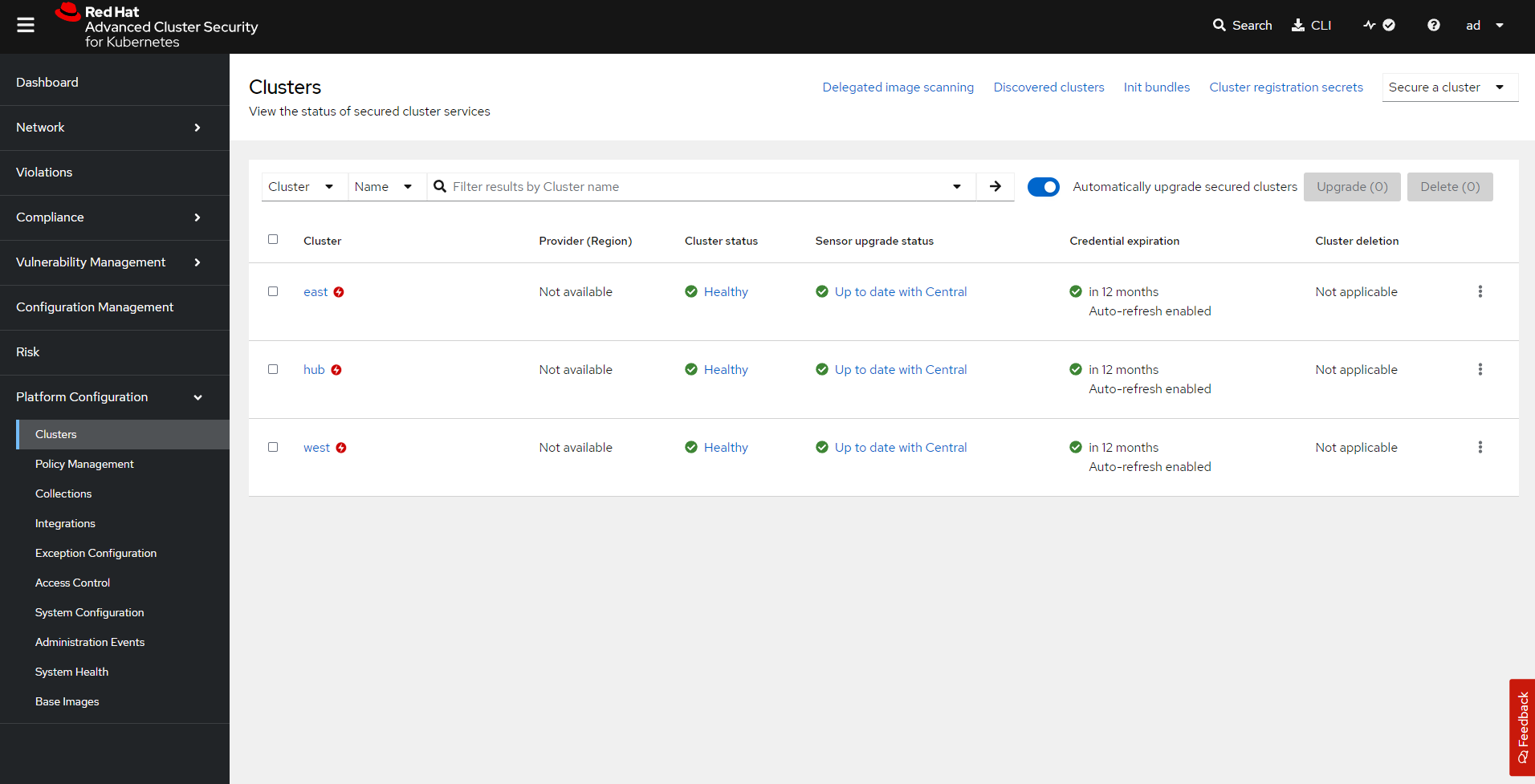
ACS Central — hub and spoke clusters registered (hub, east, west).
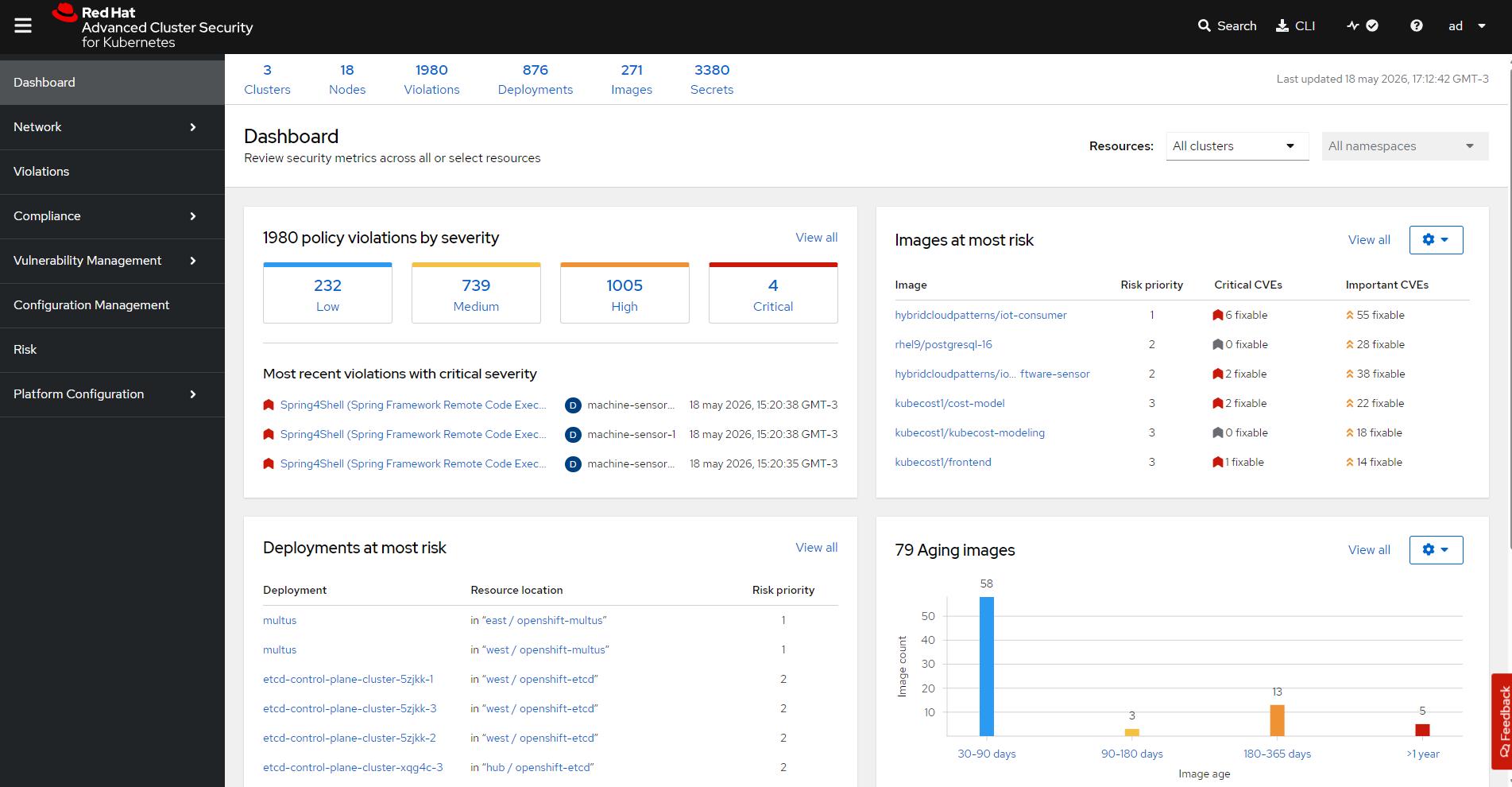
ACS Central — additional console perspective (policies, vulnerabilities, or runtime visibility).
Topology for hub-spoke
| Component | Location | Role |
|---|---|---|
| Central | Hub | Policy console, vulnerability DB integration, admission coordination |
| SecuredCluster | Hub + spokes | Sensor, collector, and admission control per cluster |
The stackrox namespace is listed in $noMeshNamespaces (charts/all/namespaces) — do not label it istio.io/dataplane-mode: ambient. Ambient ztunnel breaks Central ↔ PostgreSQL TLS and Central becomes unreachable.
Hub and spokes register with Central using init bundles (TLS secrets in namespace stackrox). Generate once per cluster from Central:
roxctl -e central.stackrox:443 --password "$ROX_ADMIN_PASSWORD" --insecure-skip-tls-verify \
  central init-bundles generate <cluster-name> --output-secrets - | oc apply -n stackrox -f -
Cluster names: hub, east, west. The rhacs-operator subscription on spokes is deployed via openshift-operators (ApplicationSet subscriptions list).
Helm chart registration (hub + spokes)
1. Prerequisites
| App | Cluster | Chart path |
|---|---|---|
acs-operator | Hub | charts/all/acs-operator |
acs-secured-cluster | Hub + spokes | charts/all/acs-secured-cluster |
acs-init-bundle-sync | Hub only | charts/all/acs-init-bundle-sync |
Sync order: operator → SecuredCluster CR → init bundle secrets (collector-tls, sensor-tls, admission-control-tls).
2. Helm values
Hub (templates/component-applications.yaml):
clusterName: hub
clusterRole: hub
centralEndpoint: central.stackrox.svc:443   # in-cluster
Spokes (east/templates/component-applications.yaml, west/...):
clusterName: east   # or west
clusterRole: spoke
hubClusterDomain: apps.cluster-<hub-id>.dynamic2.redhatworkshops.io
# centralEndpoint rendered as central-stackrox.<hubClusterDomain>:443
RHDP must inject clusters.hub.domain on spoke orders so hubClusterDomain resolves.
3. Automated init bundles (recommended)
Chart charts/all/acs-init-bundle-sync runs PostSync Job acs-init-bundle-sync-hook and CronJob every 12 hours:
- Reads
ROX_ADMIN_PASSWORDfrom Secretacs-init-credentialsinstackrox(create at runtime — never commit). - Runs
roxctl central init-bundles generateper cluster (hub,east,west). - Applies secrets on the hub via in-cluster
oc apply. - Pushes spoke bundles via ManagedClusterAction Job on each spoke.
Create the credentials Secret after Central is Ready:
oc create secret generic acs-init-credentials -n stackrox \
  --from-literal=ROX_ADMIN_PASSWORD='<central-admin-password>'
If the Secret is missing, the Job exits successfully with a log message; use manual roxctl below.
4. Manual init bundles (fallback)
On each cluster (or from hub with oc context):
export ROX_ADMIN_PASSWORD='<central-admin-password>'

# Hub
roxctl -e central.stackrox:443 --password "$ROX_ADMIN_PASSWORD" --insecure-skip-tls-verify \
  central init-bundles generate hub --output-secrets - | oc apply -n stackrox -f -

# East / west (run with spoke kubeconfig or from hub after ACM join)
roxctl -e central.stackrox:443 --password "$ROX_ADMIN_PASSWORD" --insecure-skip-tls-verify \
  central init-bundles generate east --output-secrets - | oc apply -n stackrox -f -
5. Verify registration
oc get securedcluster -n stackrox
oc get secret -n stackrox | grep -E 'collector-tls|sensor-tls|admission-control-tls'
ACS UI → Platform Configuration → Clusters should list hub, east, and west (may take a few minutes).
6. Troubleshooting
| Symptom | Fix |
|---|---|
| Central UI empty clusters | Init bundle secrets missing — run step 3 or 4 |
| Spoke cannot reach Central | Wrong hubClusterDomain; verify route central-stackrox.<hub-domain> |
| Central unreachable | stackrox namespace must not use Istio ambient |
| MCA Job fails on spoke | Ensure acs-secured-cluster synced on spoke (Role acs-init-bundle-apply grants secret apply to SA acs-init-bundle-apply) |
Developer Hub — CVE visibility for userN
| Path | Scope | Status |
|---|---|---|
| Quay plugin (entity tab) | Images pushed to org workshop | Enabled — best option for scaffolded components |
Security Insights (/rhacs proxy) | ACS image/deployment CVEs on catalog entities | Optional — set plugins.acsSecurityInsights.enabled: true if package exists in RHDH image; inject rhacsApiToken via Helm → Secret developer-hub-oidc-auth key RHACS_API_TOKEN |
| ACS Central UI | Full fleet | Facilitator/admin — requires init bundles (above) |
Prerequisite for Security Insights: clusters registered in ACS and a read-only API token from Platform Configuration → Integrations → API token.
Operator discovery
RHACS controller manager watches SecuredCluster CRs inside stackrox (platform.stackrox.io) plus Central objects where Central installs live.
Admission/collector assets reconcile once collector-tls, sensor-tls, and admission-control-tls Secrets exist — YAML manifests originate from roxctl central init-bundles generate output keyed by cluster label (Deployments do not declare ACS enrollment annotations).
Avoid istio.io/dataplane-mode: ambient on stackrox — ambient interception breaks Central ↔ PostgreSQL TLS (see topology table above).
Capabilities used
- CVE scanning for images referenced by Industrial Edge and platform workloads.
- Risk prioritization across many namespaces and clusters.
- Network and process baselines optional hardening for regulated factories.
Documentation
Chart paths: charts/all/acs-operator (hub Central), charts/all/acs-secured-cluster (hub + spokes), charts/all/acs-init-bundle-sync (hub automation).